
Losing most of your natural teeth can affect much more than your smile. It can make eating more difficult, change the appearance of the face, and affect confidence in everyday communication. For patients who have lost most or all of their teeth, full dentures can provide a practical, removable way to replace missing teeth.
At Saigon White Dental in Ho Chi Minh City, Vietnam, Anrel Krishna received a complete removable denture treatment for both the upper and lower jaws. His case demonstrates how full dentures can help restore the appearance of a complete smile while providing a removable option for extensive tooth loss.
Clinical results vary from patient to patient. A dentist must evaluate the condition of the gums, remaining teeth, jawbone, bite and overall oral health before recommending dentures.
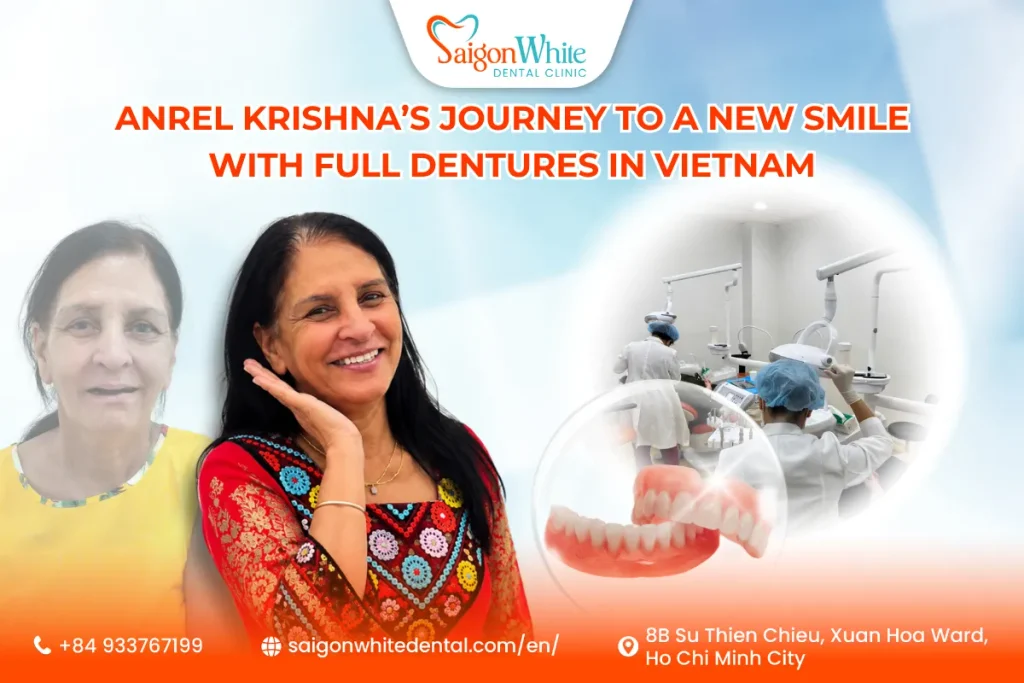
Anrel Krishna’s Full Denture Case at Saigon White Dental
Anrel Krishna came to Saigon White Dental with extensive tooth loss affecting both the upper and lower arches.
The before-treatment photographs show significant gaps where natural teeth were missing. Only several natural teeth remained, with noticeable differences in tooth condition and spacing. With so many teeth absent, restoring the entire smile required a comprehensive approach rather than replacing only one or two individual teeth.
For this case, the treatment focused on complete removable dentures for both the upper and lower arches.
The goal was to create a new set of teeth that could:
- Replace the missing teeth in both jaws
- Restore a more complete appearance
- Support everyday chewing function
- Provide a removable tooth-replacement option
- Create a more balanced and natural-looking smile
The final result shown in the after-treatment photograph presents a complete upper and lower dentition, giving Anrel a visibly fuller smile.
For patients considering full dentures in Vietnam, a real case like Anrel’s can help explain what the treatment is designed to achieve and what factors should be considered before choosing dentures.
Before and After: What Changed?
The most noticeable difference in Anrel Krishna’s case is the change from extensive tooth loss to a complete set of artificial teeth in both arches.
Before treatment
The before photograph shows:
- Extensive missing teeth in the upper and lower jaws
- Large spaces between the remaining teeth
- Several remaining teeth with visible discoloration and wear
- Limited natural tooth support across the arches
When many teeth are missing, the problem is not simply cosmetic. Tooth loss can affect chewing, speech and the way a person feels about their appearance.
After treatment
The after photo shows a noticeably more youthful and refreshed appearance after her smile was restored. The new teeth create a fuller, more balanced smile across both the upper and lower arches, giving her overall appearance a natural and confident look.
After just a few appointments, she was able to complete her full upper and lower denture treatment and enjoy her new smile. The result demonstrates one of the key benefits of conventional removable dentures: they can replace an entire arch without being permanently fixed to the jaw.
A complete denture can replace all missing teeth in the upper arch, lower arch, or both. It rests over the gums and underlying oral tissues, providing a removable solution for patients with extensive tooth loss.
What Are Full Removable Dentures?
Full removable dentures, also called complete dentures, are custom-made dental prostheses designed to replace all teeth in one dental arch.
When a patient has lost all or most of the teeth in both jaws, a dentist may recommend a complete denture for the upper jaw and another complete denture for the lower jaw.
Unlike dental implants or fixed bridges, removable dentures can be taken out for cleaning and maintenance.
Traditional complete dentures generally consist of artificial teeth attached to a gum-colored base. The exact materials and design depend on the patient’s oral condition, treatment goals and the dentist’s recommendation.
For someone with extensive tooth loss, full dentures may offer a less invasive alternative to implant-based tooth replacement.
However, they are not automatically the right choice for every patient. A professional dental examination is essential before treatment.
Why Choose Full Dentures for Extensive Tooth Loss?
There are several reasons why patients with extensive tooth loss may consider complete removable dentures.
1. They can replace an entire arch
Instead of replacing each missing tooth separately, a complete denture can restore an entire upper or lower arch.
For patients missing most or all of their teeth, this can provide a comprehensive tooth-replacement solution.
2. They are removable
One of the main characteristics of conventional dentures is that patients can remove them.
This makes daily cleaning easier and allows the gums and oral tissues to rest when the dentures are not being worn.
3. They can improve the appearance of a smile
Missing teeth can create large gaps and change the appearance of the mouth and facial profile.
A well-designed complete denture can replace visible missing teeth and provide support to the lips and surrounding facial tissues. Complete dentures are used not only to replace teeth but also to help recreate some of the support that can be lost after extensive tooth loss.
4. They do not require implant surgery
Conventional removable dentures do not require dental implants to support them.
This can make them an option for patients who prefer a non-surgical approach to replacing missing teeth.
That does not mean dentures are suitable for everyone. The dentist must still assess the condition of the gums, oral tissues, remaining teeth and jaw before treatment.
How Are Full Dentures Made?
The exact treatment sequence varies according to the patient’s condition, but complete denture treatment generally involves several important stages.
Step 1: Dental examination and consultation
The dentist first examines the patient’s mouth and evaluates the condition of the remaining teeth, gums and supporting tissues.
The dentist also discusses the patient’s expectations, appearance preferences and functional needs.
Step 2: Impressions or digital measurements
The dental team records the shape of the patient’s mouth so the denture can be custom-made.
Depending on the clinical situation, conventional impressions or digital scanning technologies may be used.
Step 3: Bite and tooth arrangement
For complete dentures, the relationship between the upper and lower jaws is important.
The dental team records the patient’s bite and determines an appropriate position for the artificial teeth. This helps the upper and lower dentures work together.
Step 4: Denture fabrication
The recorded information is sent for fabrication of the custom dentures.
The artificial teeth and denture base are designed according to the treatment plan, including factors such as tooth size, shape, position and shade.
Step 5: Try-in and adjustments
Before the final dentures are delivered, the fit and appearance are checked.
The dentist may make adjustments to improve comfort, stability and the relationship between the upper and lower teeth.
Step 6: Final fitting
Once the dentures are ready, the patient receives the completed upper and lower dentures.
The dentist checks the fit and makes any necessary adjustments.
This fitting stage is important because new dentures can initially feel unfamiliar. It may take time for the mouth, tongue and facial muscles to adapt.
Getting Used to New Full Dentures
A new set of dentures can feel different from natural teeth.
Patients may initially notice changes in:
- How the dentures feel in the mouth
- Chewing
- Speaking
- Saliva production
- The way the tongue interacts with the new teeth
This adjustment period is normal for many denture wearers.
Starting with softer foods and gradually returning to a normal diet can make the transition easier. Practising putting the dentures in and taking them out can also help patients become more comfortable with their new prostheses.
If dentures consistently cause pain, slip excessively, click while speaking or no longer fit properly, the patient should return to the dentist for an evaluation.
How to Care for Full Removable Dentures
Proper maintenance is essential for keeping removable dentures clean and comfortable.
The American Dental Association recommends daily denture cleaning to remove food particles, plaque, stains and microorganisms. Dentures should also be kept moist when they are not being worn, according to appropriate care instructions.
For conventional removable dentures:
- Remove and clean them regularly.
- Use a soft denture brush or an appropriate non-abrasive cleanser.
- Rinse them after meals when possible.
- Follow the manufacturer’s instructions for denture-cleaning products.
- Avoid hot or boiling water because it can deform the denture.
- Clean your gums, tongue and any remaining natural teeth.
- Remove the dentures at night unless your dentist gives different instructions.
If a denture becomes loose or uncomfortable, do not rely on increasing adhesive use as a permanent solution. An ill-fitting denture may require professional adjustment, relining or replacement.
Full Dentures vs Dental Implants: Which Is Better?
There is no single tooth-replacement option that is best for every patient.
Full removable dentures are removable and do not require implant surgery. They can replace an entire upper or lower arch and are often considered when patients want a non-surgical tooth-replacement option.
Dental implants, on the other hand, are fixed into the jawbone and can support crowns, bridges or certain types of dentures. Implant-supported dentures can provide greater retention than conventional removable dentures because they attach to implants.
The right choice depends on factors such as:
- Number of missing teeth
- Gum health
- Jawbone condition
- Existing oral health
- Overall health
- Budget
- Treatment preferences
- Desired stability and convenience
For this reason, a consultation should come before deciding between dentures and implants.
Why Consider Removable Dentures in Vietnam?
Vietnam has become an increasingly popular destination for international dental patients seeking tooth replacement and other dental treatments.
At Saigon White Dental, removable dentures are among the available restorative options, including both full and partial dentures. The clinic provides dental care for local and international patients in Ho Chi Minh City.
Saigon White Dental is located in District 3, Ho Chi Minh City, and provides English-language support for international patients. The clinic also states that it uses digital X-ray, 3D dental scanning and CAD/CAM technology across its dental services.
However, technology alone does not determine whether dentures are appropriate. Every full denture case should begin with an individual examination and treatment plan.
Frequently Asked Questions About Full Dentures in Vietnam
Can full dentures replace all teeth?
Yes. Complete or full dentures are designed to replace all missing teeth in an upper arch, lower arch or both.
Can I get full dentures for both the upper and lower jaws?
Yes. Patients who have extensive tooth loss in both jaws may receive a complete upper denture and a complete lower denture, as seen in Anrel Krishna’s case.
Are full dentures removable?
Yes. Conventional full dentures are designed to be removed by the patient for cleaning and maintenance.
How long do full dentures last?
The lifespan varies depending on the material, fit, oral changes and how the dentures are maintained. Cleveland Clinic notes that the average denture lifespan is around seven to 10 years, although individual dentures may need adjustment, repair or replacement sooner.
Are full dentures comfortable?
Comfort depends heavily on the fit, oral anatomy and adaptation period. New dentures may initially feel unusual, and adjustments may be necessary. If a denture causes persistent pain or becomes loose, the patient should have it professionally assessed.
Are dentures better than implants?
Not necessarily. Dentures and implants have different advantages and limitations. A dentist should evaluate the patient’s oral condition, expectations and treatment goals before recommending one option.
Restore Your Smile with Full Dentures in Vietnam
Anrel Krishna’s case shows how full removable dentures can transform a smile when extensive tooth loss affects both the upper and lower jaws.
From the before photographs showing significant tooth loss to the completed upper and lower dentures, the treatment provides a practical way to replace missing teeth without implant surgery.
If you are considering full dentures in Vietnam, the first step is not choosing a material or comparing prices. It is understanding your oral condition and finding out which treatment is appropriate for you.
At Saigon White Dental in Ho Chi Minh City, our dental team provides personalized consultations for patients considering removable dentures, full dentures and other tooth-replacement options.
Book a consultation with Saigon White Dental to discuss your full denture options in Vietnam and receive a treatment plan based on your individual needs.
About Saigon White Dental
Saigon White Dental Clinic is located at 8B Su Thien Chieu, District 3, Ho Chi Minh City, Vietnam. The clinic serves both local and international patients and provides English-language support throughout the dental care journey.
Phone / WhatsApp: +84 933 767 199
Opening hours: Monday–Saturday, 8:00 AM–6:00 PM
 Messenger FB
 WhatsApp
 Book now