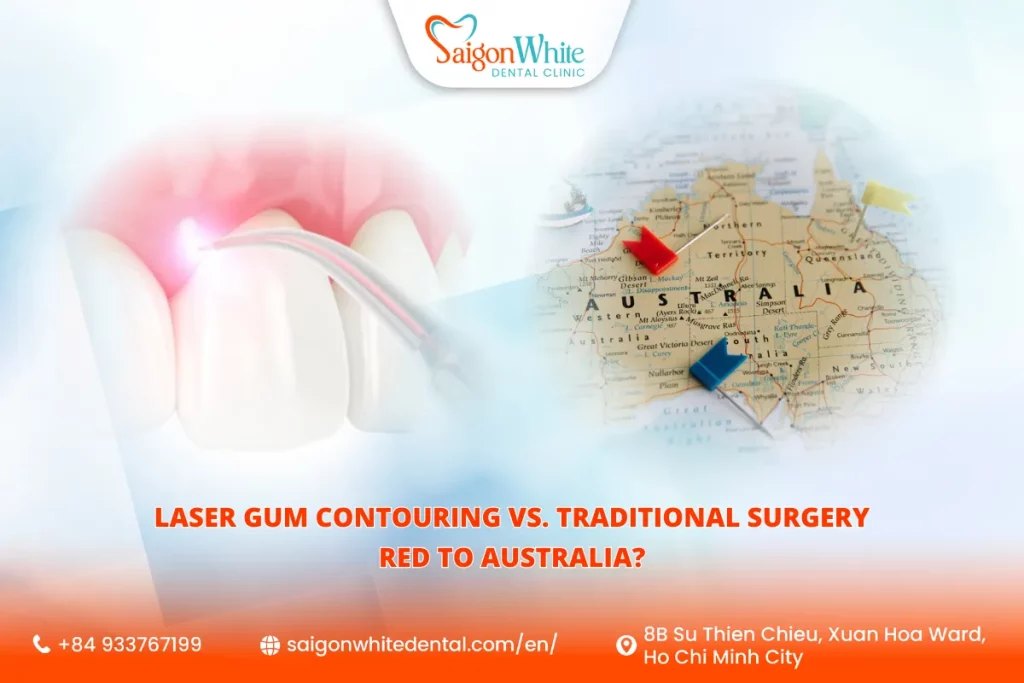
Laser Gum Contouring is transforming modern cosmetic dentistry by offering a faster, safer, and more precise way to perfect your smile. Unlike traditional methods using scalpels and stitches, this advanced technique gently reshapes gums with minimal pain and recovery time.
So, when it comes to Laser Gum Contouring vs. Traditional Surgery, which option gives better results? Let’s explore why more patients — especially in Vietnam — are choosing laser technology for a balanced, confident smile.
1. What Is Gum Contouring and Why Is It Done?
Gum contouring is a cosmetic dental procedure that reshapes the gum line to improve smile symmetry and proportion. It’s commonly used for people with a “gummy smile” — when too much gum tissue covers the teeth — or those with uneven gum levels that make teeth appear shorter or misaligned.
The goal of gum contouring is to create a more balanced appearance between your teeth and gums, enhancing your smile aesthetics and boosting confidence. In some cases, gum contouring can also have functional benefits, such as improving oral hygiene by reducing gum pockets where bacteria can accumulate.
Common reasons people seek gum contouring include:
- Excess gum tissue covering the teeth
- Uneven gum lines that affect smile symmetry
- Preparation for veneers, crowns, or smile makeovers
- Correcting gummy smiles caused by genetics or medication
2. Traditional Gum Surgery: The Conventional Method
Before lasers became mainstream, gum reshaping was performed using traditional surgery techniques — mainly scalpels and surgical instruments.
How Traditional Surgery Works
- Local anesthesia is administered to numb the gums.
- The dentist uses a scalpel to remove excess gum tissue and shape the new gum line.
- If necessary, small stitches (sutures) are placed to control bleeding and promote healing.
- The patient returns after a few days for follow-up and suture removal.
Advantages of Traditional Surgery
- Allows for precise control when bone reshaping is needed.
- Effective for complex periodontal or structural corrections.
- Generally, lower upfront cost compared to laser treatment.
Disadvantages
- More bleeding during and after the procedure.
- Longer recovery time (typically 1–2 weeks).
- Higher risk of infection due to open wounds.
- May result in post-operative pain and swelling.
While effective, traditional surgery can feel intimidating for many patients. The discomfort and recovery period often discourage people from pursuing this otherwise simple aesthetic treatment.
3. What Is Laser Gum Contouring?
Laser gum contouring is a modern, minimally invasive alternative that uses dental lasers — such as diode, CO₂, or Er: YAG lasers — to gently remove and reshape excess gum tissue. The laser both cuts and cauterizes simultaneously, minimizing bleeding and promoting faster healing.
How It Works
- The dentist applies topical or local anesthesia for comfort.
- A soft-tissue laser is used to trim, sculpt, and reshape the gum line.
- The laser’s heat seals blood vessels, eliminating the need for stitches.
- The entire process usually takes 30–60 minutes, depending on the case.
Benefits of Laser Technology
- Virtually painless procedure.
- Little to no bleeding due to instant cauterization.
- Reduced infection risk since lasers sterilize the area.
- Faster recovery — usually within 1–3 days.
- High precision, especially for cosmetic smile design.
Laser gum contouring represents a fusion of science and aesthetics, allowing dentists to craft symmetrical, natural-looking smiles with exceptional accuracy.
4. Laser vs. Traditional Surgery: Head-to-Head Comparison
| Feature | Laser Gum Contouring | Traditional Surgery |
|---|---|---|
| Technology Used | Dental laser (Diode, CO₂, Er:YAG) | Scalpel and surgical instruments |
| Pain Level | Minimal; often no stitches required | Moderate; may need sutures |
| Bleeding | Very little (laser seals vessels) | Noticeable bleeding |
| Healing Time | 1–3 days | 1–2 weeks |
| Precision | High (laser-guided) | Manual control, less precise |
| Infection Risk | Extremely low (sterile environment) | Higher risk from open wounds |
| Cost | Slightly higher | Lower upfront cost |
| Aesthetic Result | Smooth, clean gum line | May require refinement |
In short, laser gum contouring offers greater comfort, precision, and faster recovery, while traditional surgery remains ideal for complex or structural cases involving bone or deep tissue work.
5. Advantages of Laser Gum Contouring
Modern dentistry embraces laser technology because of its multiple patient benefits. Here are the main reasons it’s becoming the preferred method:
Painless Experience
The laser’s heat naturally seals nerve endings as it works, drastically reducing discomfort during and after treatment.
Fast Recovery
Healing usually takes just a few days, allowing patients to resume normal activities almost immediately.
Enhanced Safety
The laser sterilizes as it cuts, minimizing the risk of infection and eliminating the need for sutures.
High Precision and Control
Dentists can sculpt tissue with millimeter-level accuracy, ensuring symmetry for an aesthetically pleasing smile.
Minimal Swelling and Bleeding
Because there’s no mechanical cutting, the tissue trauma is much lower than with scalpels.
Predictable, Natural Results
The smooth finish left by the laser provides a clean gum line that enhances the visual harmony of teeth and gums.
6. When Traditional Surgery Is Still the Better Option
While laser contouring dominates cosmetic dentistry, there are scenarios where traditional gum surgery is still necessary:
- Excessive gum tissue is caused by a bone structure that requires bone removal.
- Severe periodontal (gum) disease where deep cleaning or flap surgery is needed.
- Cases involving structural jaw alignment issues that need surgical correction.
- Complex smile designs where both gum and bone levels must be adjusted together.
In such cases, traditional surgery allows dentists to manually adjust bone and soft tissue, something lasers can’t fully replace.
7. Choosing the Right Method: Factors to Consider
The decision between laser and traditional gum contouring depends on several key factors:
The Cause of the Gummy Smile
If your issue is purely soft-tissue excess, laser contouring is ideal. But if it’s related to bone positioning or gum disease, traditional surgery may be necessary.
Treatment Goals
Patients seeking purely cosmetic improvements often prefer lasers for their comfort and speed. Those needing medical correction may require surgical precision.
Budget and Time
Laser treatment costs slightly more per session but saves time and recovery days, which can be more convenient for international patients.
Dentist’s Recommendation
An experienced cosmetic dentist or periodontist will evaluate your smile, X-rays, and gum health before advising the most suitable option.
8. Gum Contouring in Vietnam: Modern Care at Affordable Prices
Vietnam has become a leading destination for cosmetic dentistry, attracting patients from Australia, the U.S., Europe, and Asia. Clinics in Ho Chi Minh City, Hanoi, and Da Nang now offer laser gum contouring using cutting-edge technology, delivering world-class results at a fraction of Western prices.
Why Patients Choose Vietnam
- Internationally trained dentists (many educated in Australia or Japan).
- State-of-the-art equipment, including diode and CO₂ lasers.
- Affordable prices — up to 70–80% cheaper than Western countries.
- English-speaking dental clinics that cater to international patients.
- Opportunity to combine dental care with tourism in a beautiful, welcoming country.
Typical Price Range
| Treatment Type | Cost in Vietnam (USD) | Cost in U.S. / Australia (USD) |
|---|---|---|
| Laser gum contouring | $80 – $150 per tooth | $300 – $600 per tooth |
| Traditional gum surgery | $200 – $400 per tooth | $700 – $1,200 per tooth |
9. Saigon White Dental – Expert in Laser Gum Contouring
Among the top clinics offering modern gum reshaping, Saigon White Dental in Ho Chi Minh City stands out for its advanced technology and patient-centered care.
Highlights:
- Uses FDA-approved laser systems for painless contouring.
- Offers 3D smile design previews before treatment.
- Team of English-speaking dentists trained in international cosmetic standards.
- Transparent pricing, sterilization protocols, and follow-up support.
Foreign patients often combine laser gum contouring here with veneers, teeth whitening, or smile makeovers, completing all procedures in a single short trip.
10. Aftercare and Recovery Tips
Whether you choose laser or traditional surgery, following proper aftercare ensures faster healing and the best results.
Post-Treatment Care Guidelines:
- Avoid spicy, crunchy, or hot foods for the first few days.
- Maintain good oral hygiene, but brush gently near treated areas.
- Rinse with warm saltwater or prescribed mouthwash.
- Use pain relievers or antibiotics only as advised by your dentist.
- Avoid smoking or alcohol until full recovery.
Most patients who undergo laser contouring report minimal discomfort and resume normal eating within 24–48 hours, whereas traditional surgery patients may need a week or more to fully recover.
11. Frequently Asked Questions (FAQ)
Q1. Is laser gum contouring painful?
No. The laser seals nerves and blood vessels, making the process nearly pain-free with little to no bleeding. Local anesthesia ensures complete comfort.
Q2. How long does the procedure take?
Laser contouring usually takes 30–60 minutes, while traditional surgery can take up to 90 minutes, depending on complexity.
Q3. Are the results permanent?
Yes. Once the excess tissue is removed and healed, the results are long-lasting unless gum growth is caused by medical conditions or medication.
Q4. Can I combine this with other treatments like veneers?
Absolutely. Many dentists perform gum contouring before veneers or crowns to enhance smile proportion and aesthetics.
Q5. Is it safe for foreigners in Vietnam?
Yes. Reputable clinics follow international sterilization and safety standards, and English-speaking staff make the process easy and stress-free.
 Messenger FB
 WhatsApp
 Book now